
Compact plants and wastewater treatment retrofits
How prefabrication, equipment integration, and retained infrastructure can simplify a treatment plant.
Read articleDomestic treatment plant modernization
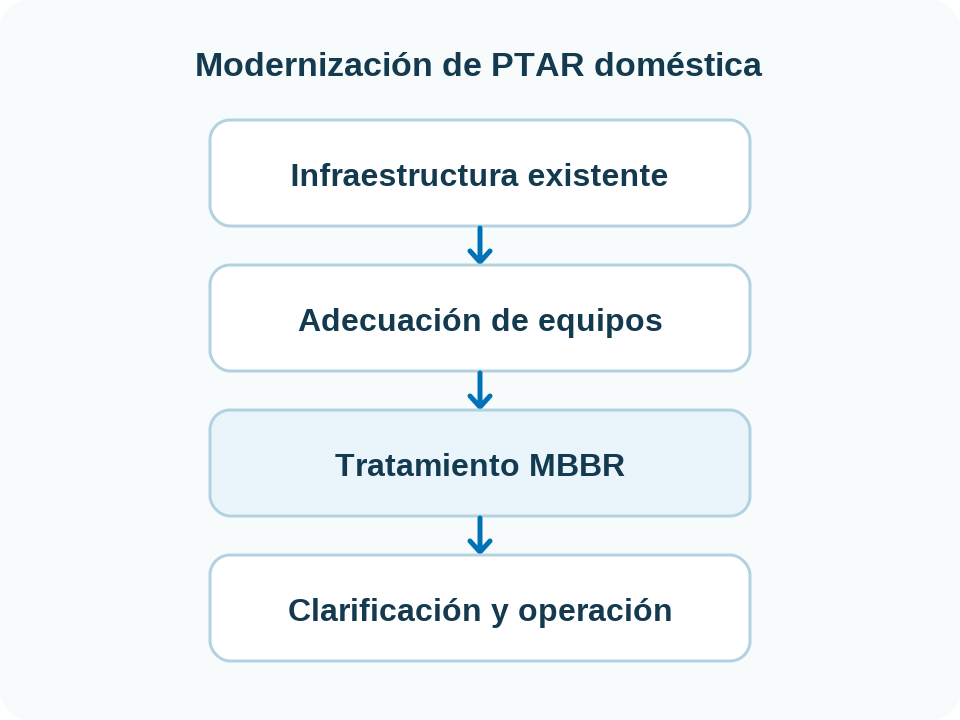
At Ultracem in Galapa, Vandens upgraded domestic wastewater treatment designed for 0.8 L/s with two new reactors, an existing clarifier and renewed pumps, aeration, controls and piping.
A concrete-production facility also generates domestic wastewater in its sanitary services. At Ultracem, the challenge was not industrial-process wastewater: it was upgrading the plant treating this domestic stream while retaining infrastructure that still served a purpose.
The Ultracem treatment plant in Galapa handled domestic wastewater. Its location within an industrial facility does not make this stream industrial process wastewater: the system needed to treat sanitary discharges using existing infrastructure and with practical operational continuity.
The proposal used a design flow of 0.8 liters per second, equivalent to 28.8 m³ over ten hours of generation. This figure informed the upgrade design; it is not a measured post-upgrade throughput.
Vandens replaced the horizontal tank with two biological reactor tanks. The original offer describes two fiberglass reactors of approximately 4 m³ each, arranged for a moving-bed biofilm treatment process.
The existing settling tank was retained as part of the new layout. That decision avoided replacing a useful asset and focused construction work on the biological volume and its connections.
The work included new pumps, blowers and a control panel. All air, water and sludge pipework was replaced as well. Aeration, hydraulic transfer and solids handling were addressed as parts of the same modernization.
This case shows that a plant upgrade does not need to mean tearing everything down. Identifying what to retain and what to replace directs investment toward the components that matter in day-to-day operation.
Separate vessels organize the biological stages, aeration, and flow more clearly.
A structure that continued to serve the process remained in the renewed train.
Air, water, and sludge lines were renewed as one coordinated system rather than isolated repairs.
Pumps, blowers, and the control panel support the new treatment configuration.
How prefabrication, equipment integration, and retained infrastructure can simplify a treatment plant.
Read articleApplications, retrofits, reliability, aeration, maintenance, and process constraints.
Read articleFlow, loads, target quality, process train, validation, and operating conditions.
Read articleTell us what wastewater you need to treat, what infrastructure you already have and how the plant needs to operate.
Optional analytics
May we collect aggregate usage statistics to improve this website? We do not share contact inquiry details. Declining does not affect the site.