
Why nitrogen removal matters
Why can a treatment plant remove organic matter and still need additional nitrogen treatment? Because different microorganisms and operating conditions are involved.
Two environments, two transformations
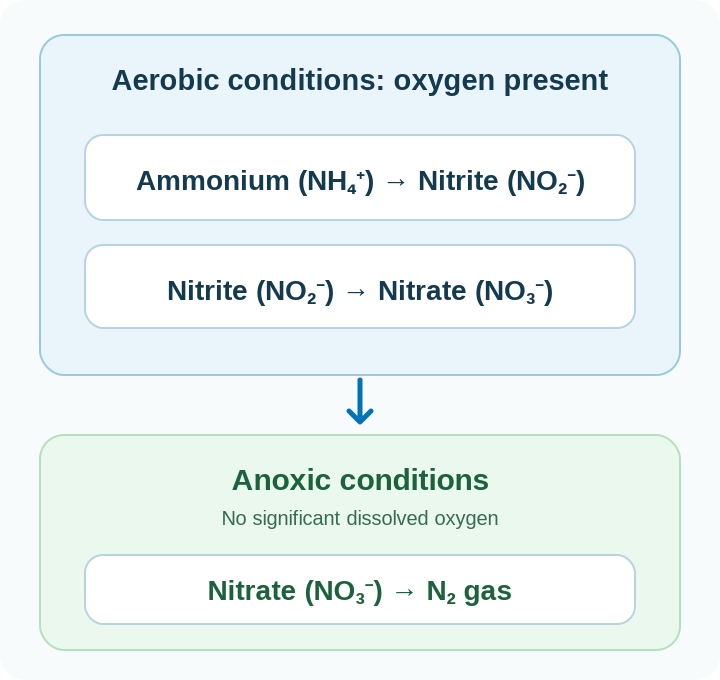
During nitrification, autotrophic microorganisms oxidize ammonium first to nitrite and then nitrate. It is an aerobic process sensitive to dissolved oxygen, temperature, pH, alkalinity, biomass age, and inhibitors.
During denitrification, heterotrophic microorganisms use nitrate or nitrite under anoxic conditions and produce nitrogen gas. They need an available carbon source. A continuously aerated reactor does not by itself provide the same condition as a designed anoxic zone.
Why not every MBBR denitrifies
An aerobic MBBR can be designed to oxidize organic matter and, when conditions allow, nitrify. Total nitrogen removal requires examining what happens to nitrate, where an anoxic environment exists, how carbon is supplied, and how flows are recycled.
Unwanted denitrification can also occur in a clarifier when sludge remains without oxygen and nitrate and carbon are present; generated gas can float solids. That operating phenomenon does not replace a controlled removal strategy.
Design with measurements and a mass balance
Ammonium, nitrite, nitrate, total nitrogen, COD, alkalinity, oxygen, and temperature must be interpreted at defined points and times. The permit or final use sets the objective; design rates depend on the water and should not be copied from another project as universal constants.
- Aerobic zone: oxygen available for nitrification.
- Anoxic zone: no significant dissolved oxygen, with nitrate available.
- Carbon: required for heterotrophic denitrification.
- Control: stage-by-stage sampling to locate each nitrogen transformation.
Related reading and regulations
Related solutions
Wastewater treatment
Wastewater treatment engineering from characterization and design through construction, commissioning, and operation.
Explore the solutionModernization and operations
Assessment, upgrades, automation, maintenance, and optimization for existing treatment plants.
Explore the solutionRelated projects
Serena del Mar — Treatment engineering in Cartagena
In Cartagena, Vandens integrated two MBBR reactors, MC clarification, aeration, pipework and automation into a wastewater plant designed for practical operating access.
View projectWhat water do you have, and what do you need to achieve?
We can review the source, destination, and available information to identify the next step.
Request a Quote