How treatment solutions are designed
Flow, loads, target quality, process train, validation, and operating conditions.
Read articleEngineering proposal
For cosmetics-manufacturing wastewater in Cali, Vandens designed a scalable industrial solution with 42–86 m³/day phased capacity, combining DAF, two MBBR stages, MC clarification and polishing.
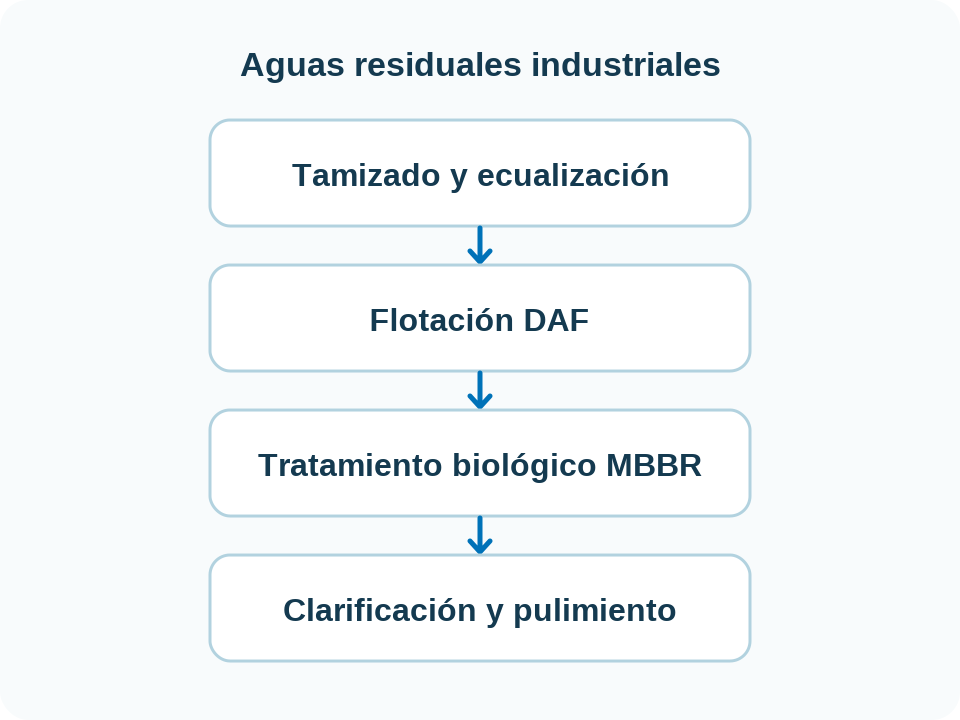
Cosmetics manufacturing can generate wastewater containing oils, fats, solids and dissolved organic compounds. A single tank cannot address all those fractions in the same way. For Recamier, Vandens proposed a staged approach: remove the materials that hinder biological treatment, then treat biodegradable matter and prepare the effluent for its intended destination.
Wastewater from cosmetics production behaves differently from sanitary wastewater. It may contain emulsions, fats, oils, solids and dissolved organic compounds that require different operations. Sending everything directly to one biological reactor would make the process harder to control.
The Recamier proposal starts by deciding which substances should be separated before microorganisms take over. It therefore combines screening, an equalization tank to balance changes in flow and a physical-chemical preparation stage.
pH adjustment, coagulation and flocculation gather particles and materials that are difficult to settle. Dissolved-air flotation (DAF) uses fine bubbles to lift fats, oils and solids out of the stream. Removing a portion of this load first prepares the water for biological treatment.
The design then passes through two AGAR® MBBR reactors and MC clarification. The moving carriers provide protected surfaces for biofilm that breaks down biodegradable organic matter, while clarification removes solids leaving the reactors.
Downstream of biology, the proposed train includes sand filtration and activated carbon. These operations do different jobs: filtration retains particles, while activated carbon can adsorb selected dissolved compounds.
Solids removed during flotation and clarification follow a separate line for thickening and filter-press dewatering. Sludge handling is therefore built into the process rather than becoming an afterthought once the treatment plant is designed.
The proposal sets out three design capacities: 42, 60 and 86 m³/day. It also considers keeping existing equalization tanks and tertiary equipment. Together, these choices make it possible to plan expansion as a sequence of investments rather than redesigning the whole plant at each step.
The commercial value lies in choosing the stages the wastewater actually needs and planning growth around a consistent process. The interactive diagram lets visitors follow the train and see why each operation comes where it does.
2020 technical offer. Select a stage to enlarge its role and follow the water and sludge routes.
Stage function
A motorized screen removes coarse solids before the remaining operations.
Chemical conditioning and DAF remove fats, oils, and solids ahead of biology.
Biological treatment is divided to address the organic load of the process water.
Sand and activated carbon complement clarification for the design objective.
Thickening and filter-press dewatering keep solids handling separate from the main flow.
Flow, loads, target quality, process train, validation, and operating conditions.
Read articleFrom river stones to treatment reactors: how communities of microorganisms help clean water.
Read articleApplications, retrofits, reliability, aeration, maintenance, and process constraints.
Read articleTell us what wastewater you need to treat, what infrastructure you already have and how the plant needs to operate.
Optional analytics
May we collect aggregate usage statistics to improve this website? We do not share contact inquiry details. Declining does not affect the site.