
Three fundamentals of wastewater treatment
What happens to wastewater as it moves through a treatment plant? First remove interfering materials, then transform contaminants and finally separate the resulting solids.
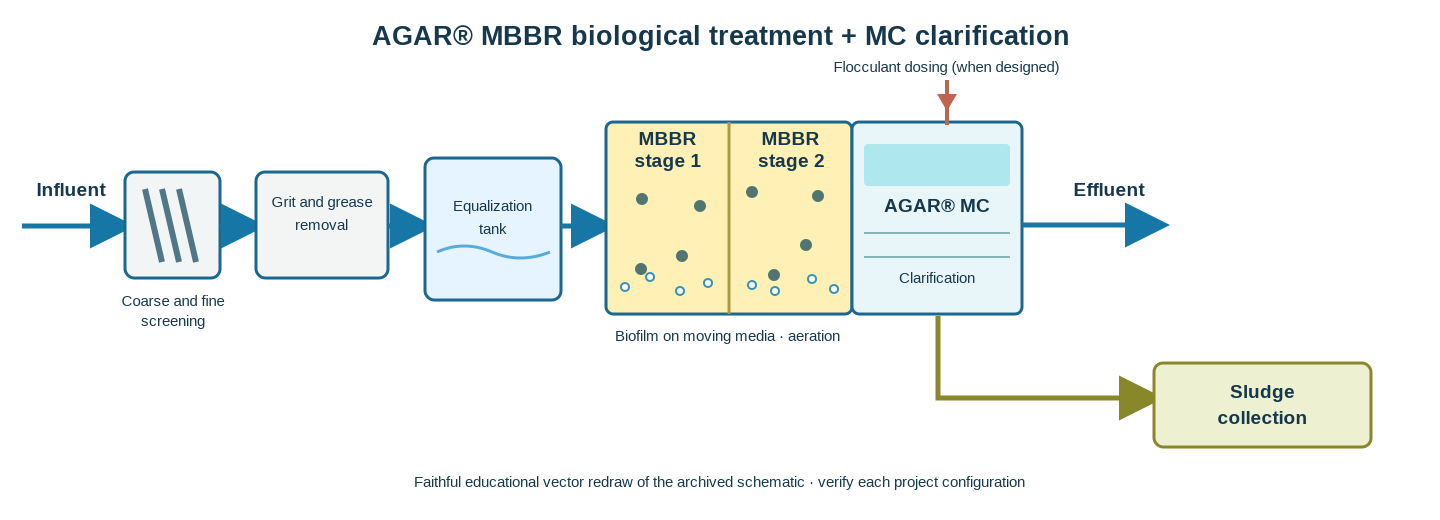
Source example: Hidroituango ZIOP plant
These three sheets show how a real process connects water, sludge, and air routes with its instrumentation.
Use the buttons or the +, − and 0 keys. Drag or swipe to move across the drawing.
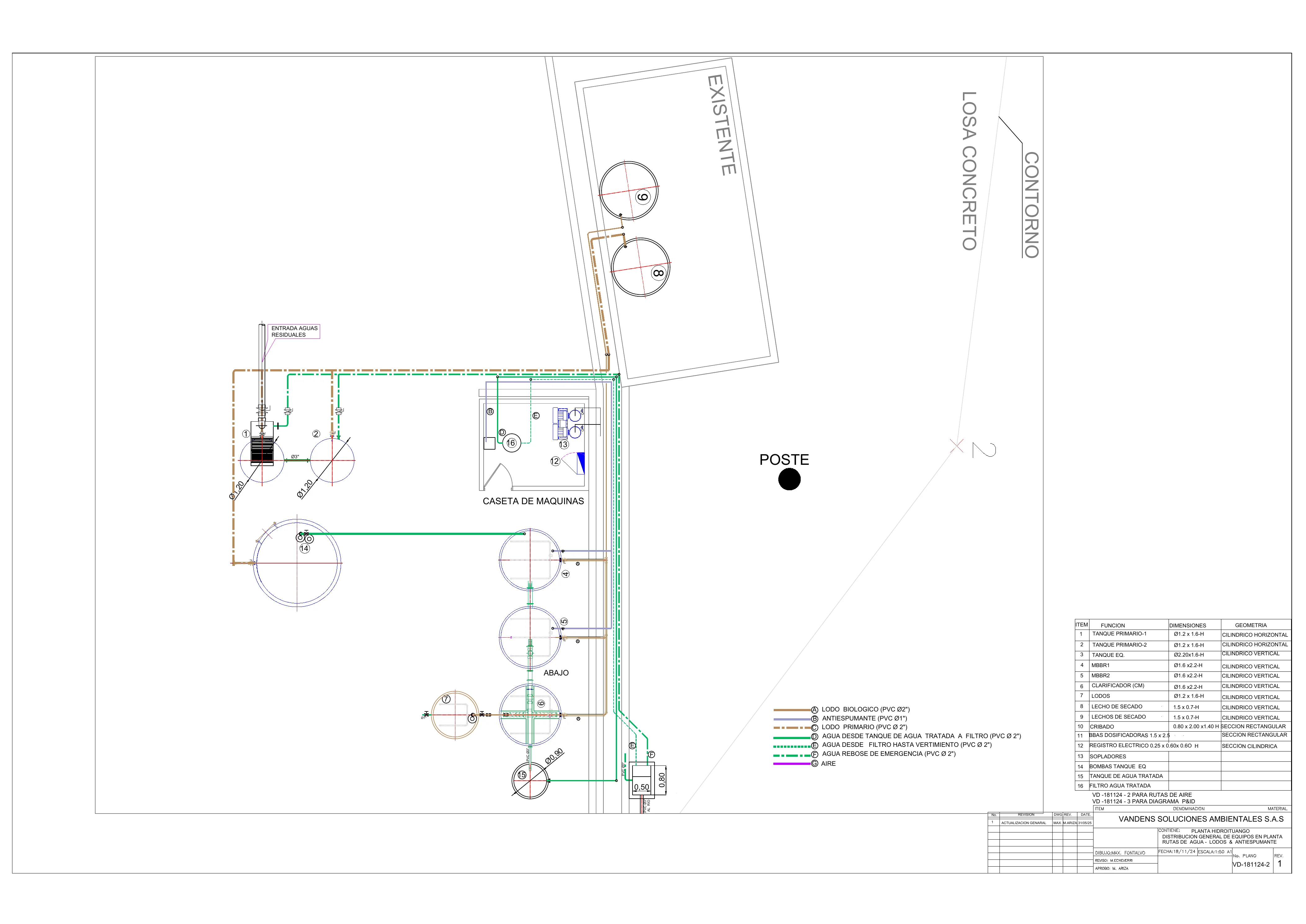
Source route for primary treatment, two MBBR stages, clarification, storage, filtration, and sludge.
Open source drawing as PDF ↗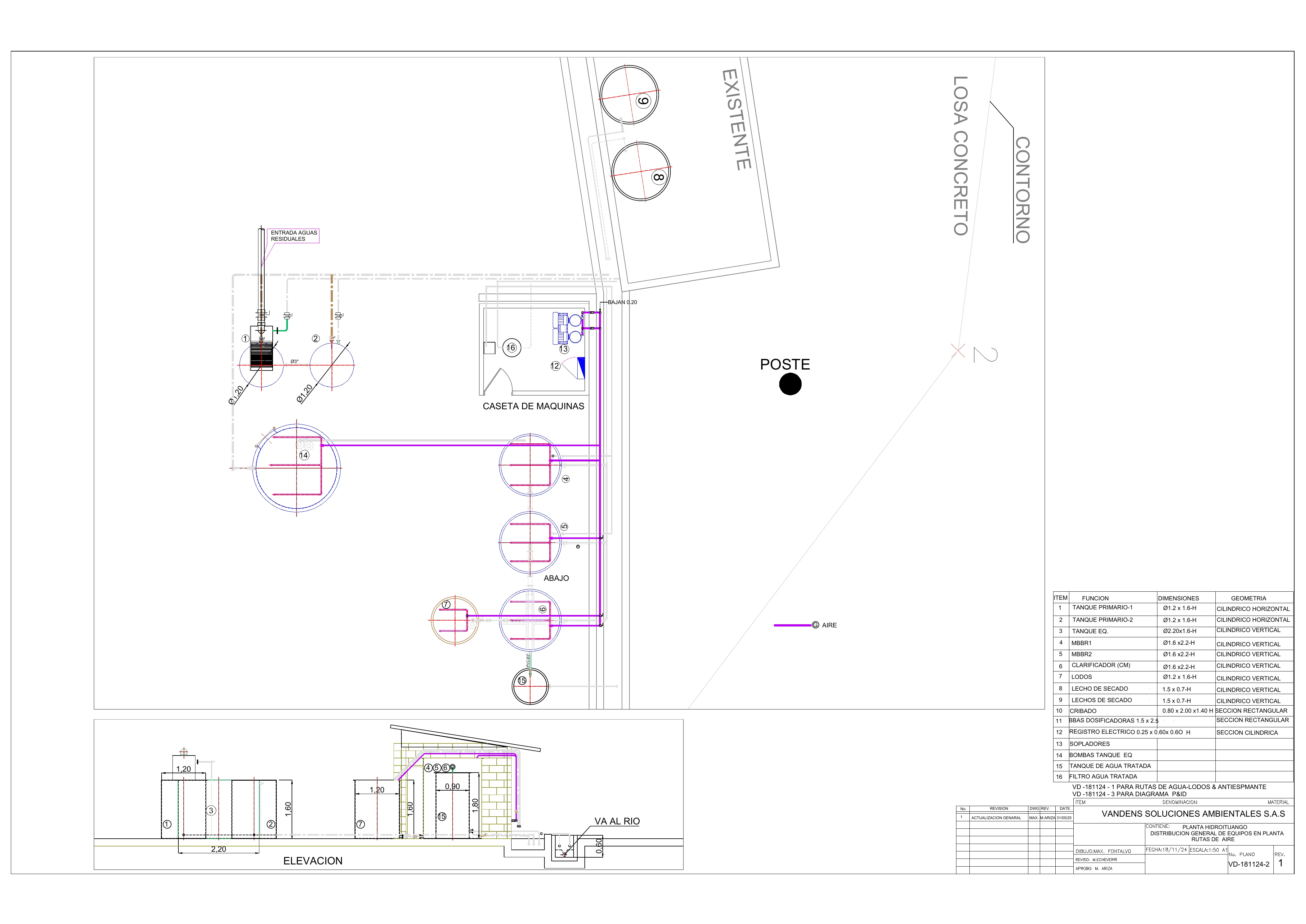
Blowers, headers, and air branches to the reactors and auxiliary equipment.
Open source drawing as PDF ↗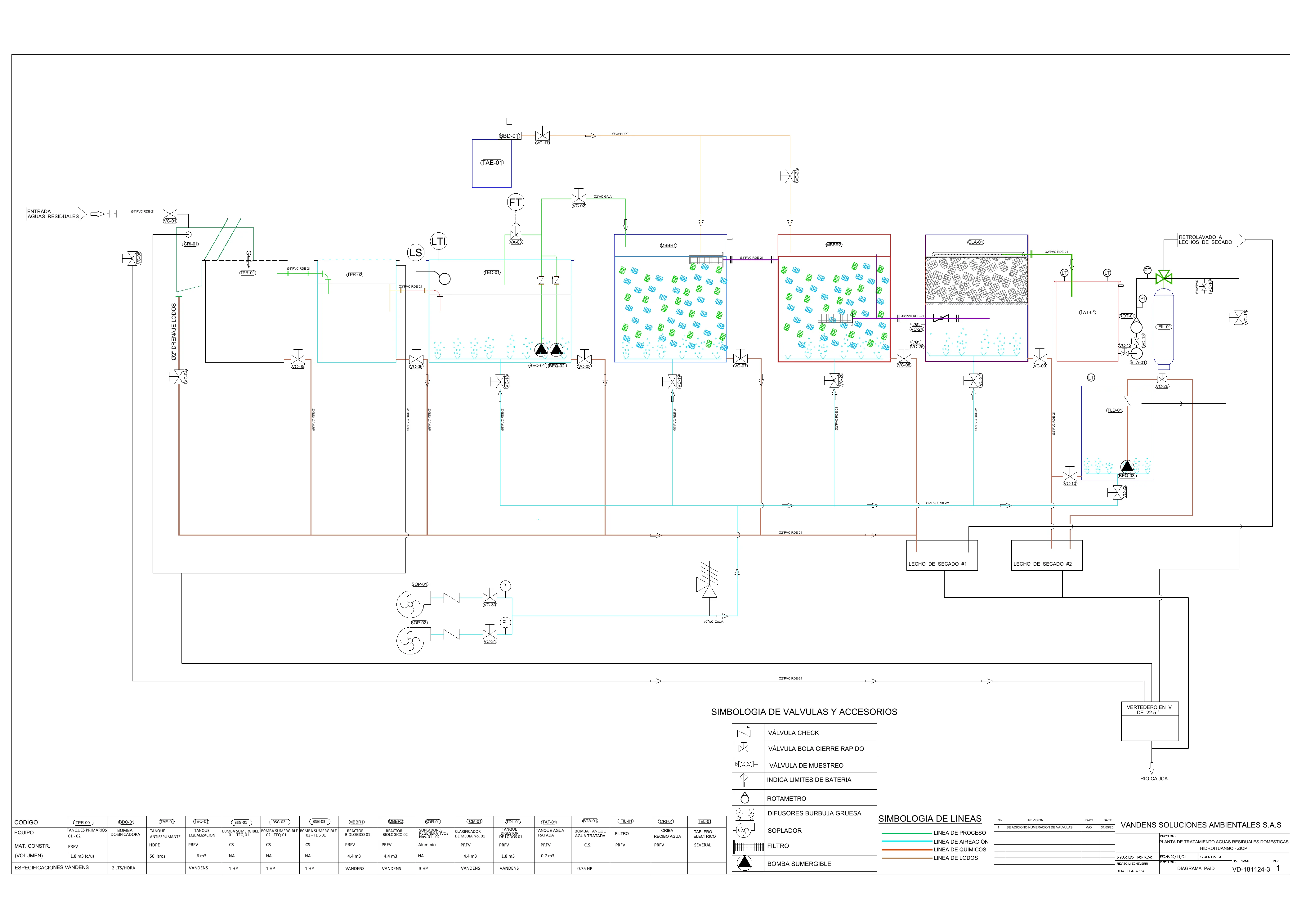
Tanks, pumps, valves, instruments, and process-control loops.
Open source drawing as PDF ↗Linear process description
- Water, sludge, and antifoam. Source route for primary treatment, two MBBR stages, clarification, storage, filtration, and sludge.
- Air distribution. Blowers, headers, and air branches to the reactors and auxiliary equipment.
- Equipment and control P&ID. Tanks, pumps, valves, instruments, and process-control loops.
1. Prepare the wastewater for treatment
Flow describes how much volume arrives; concentration describes contaminant per unit volume; load combines the two. Streams with the same flow can require very different plants when BOD, COD, TSS, fats, nutrients, toxicity, or hourly variation differ.
Preliminary treatment removes materials that can damage pumps or interfere with later stages. Equalization buffers flow and load peaks; it does not remove pollution by itself.
2. Put microorganisms to work
In a biological reactor, microorganisms use biodegradable matter and nutrients under controlled conditions. In MBBR, biomass grows as biofilm on moving carriers, while aeration provides oxygen and mixing in an aerobic process.
Vandens brings biological treatment together with the preliminary treatment, solids separation and polishing that each wastewater stream needs.
3. Separate, polish, and verify
Solids and biomass remain after the reactor and must be separated. Clarification, filtration, adsorption, and disinfection perform different jobs and are included only when the design calls for them.
Treated water heads toward its discharge or intended use while sludge follows a separate handling route. Instruments and sampling help operators manage both streams.
- Influent and equipment protection.
- Flow and load equalization.
- Biological or physicochemical transformation.
- Solids separation and sludge handling.
- Polishing, disinfection, and verification for the destination.
Related solutions
Wastewater treatment
Wastewater treatment engineering from characterization and design through construction, commissioning, and operation.
Explore the solutionRelated projects
Serena del Mar — Treatment engineering in Cartagena
In Cartagena, Vandens integrated two MBBR reactors, MC clarification, aeration, pipework and automation into a wastewater plant designed for practical operating access.
View projectRecamier — Industrial wastewater treatment design
For cosmetics-manufacturing wastewater in Cali, Vandens designed a scalable industrial solution with 42–86 m³/day phased capacity, combining DAF, two MBBR stages, MC clarification and polishing.
View projectWhat water do you have, and what do you need to achieve?
We can review the source, destination, and available information to identify the next step.
Request a Quote